AI SEO

What Is Generative Engine Optimization (GEO) and How to Optimize for AI Search​

GEO Generative Engine Optimization concept for AI search visibility

A practical, evidence based guide to Generative Engine Optimization and AI search visibility.

Executive summary

Search is changing. Users still click results, but they also ask AI systems for direct answers. These systems retrieve pages, extract sections, and generate a response.

Generative Engine Optimization

GEO is the practice of making content easy for AI systems to understand, extract, and represent accurately. GEO builds on SEO fundamentals, but it prioritizes semantic clarity, entity coverage, and trust signals.

In simple terms, classic SEO aims to rank pages. Generative Engine Optimization aims to make pages quotable. The goal is reliable interpretation, not just visibility.

This guide explains how AI search works, what makes content reusable, and how to apply a repeatable Generative Engine Optimization framework for long term AI search visibility.

The evolution of search

Traditional search engines rank documents. Over time, search introduced direct answer features such as snippets. AI driven experiences go further. They synthesize answers from multiple sources.

This changes competition. You do not only compete for rankings. You compete for inclusion in a generated answer.

SEO vs AEO vs GEO

These approaches overlap, but the target outcome is different. Understanding the differences helps you choose the right structure for each page.

APPROACH

Main target

Primary success signal

Best content format

SEO

Search results visibility

Rankings and organic traffic

Landing pages, guides, blogs

AEO

Direct answers

Snippets and question features

Short answers, lists, concise FAQs

GEO

AI generated answers

Being summarized or cited

Structured pillar guides with clear entities

AEO focuses on answer formatting. Generative Engine Optimization adds deeper requirements. It improves how content is extracted and how reliably it can be reused.

How AI search systems work

Most AI driven search experiences follow a similar pipeline. The names differ, but the logic is stable. Understanding the pipeline is core to Generative Engine Optimization.
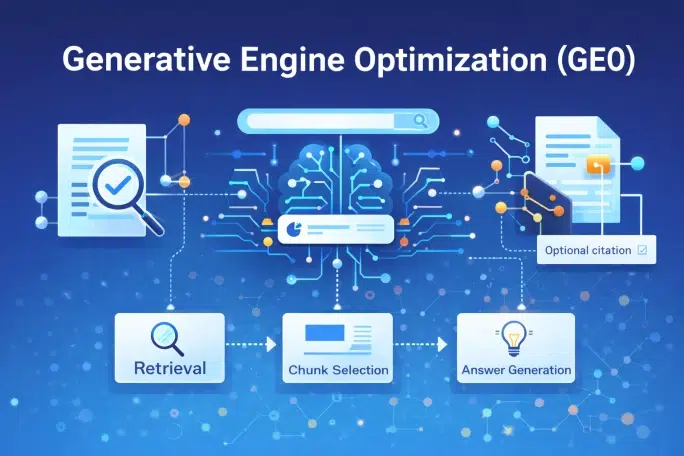
How AI search retrieves chunks and generates answers for Generative Engine Optimization
A typical AI search workflow: retrieve sources, extract chunks, synthesize an answer, optionally cite.
Step 1

Retrieval

The system selects documents that appear relevant to the query. This is similar to classic search retrieval, but the next steps change what matters.

Step 2

Chunk extraction

Instead of using full pages, the system extracts smaller sections. These sections are often treated as answer units. If your page is dense, the best chunk may not be found.

Step 3

Synthesis

The system blends chunks into a single response. It compresses information. It rewrites. This is where vague wording becomes risky.

Step 4

Attribution and citations

Some systems cite sources. Citations are more likely when statements are clear, specific, and easy to verify. That is a major goal of Generative Engine Optimization.

Why traditional SEO alone is not enough

Classic SEO remains essential. You still need strong crawlability and good performance. But AI answers introduce new failure modes.

Ranking does not guarantee inclusion

A page can rank well but still be ignored if the most useful chunk is unclear or hard to extract.

Keyword repetition does not equal meaning

AI systems rely more on semantic relationships than exact keyword density. Over repetition can even reduce clarity.

Poor structure leads to poor representation

If your page mixes topics, the model can merge ideas incorrectly. If your definition is missing, the model may use another source.

What makes content quotable in AI answers

Quotable content tends to share the same traits. These traits help humans and machines.

  • Early definition. The main concept is defined near the top.
  • Stable terminology. Key terms are consistent across the page.
  • Short claim units. Important points are in short paragraphs or lists.
  • Concrete scope. Claims are bounded, not exaggerated.
  • Trust cues. Updates, authorship, and reliable references are present.

Structured data and machine interpretability

Structured data helps systems interpret page meaning more precisely. It does not guarantee rankings or AI citations, but it reduces ambiguity and supports richer understanding.

If you want the official baseline, review the guidance here:
Google Search Central structured data overview.

For Generative Engine Optimization, the practical goal is clarity. When a page is easier to interpret, extraction quality improves.

Rich Results and Enhanced Search Features

Rich results are enhanced search features that appear with additional visual or structured elements, such as FAQs, product details, or review snippets. These features are supported by structured data.

According to official documentation from
Google Search Central, structured data helps search systems understand page meaning more clearly and may enable certain enhanced result types.

Rich results do not guarantee rankings. They do not guarantee inclusion in AI generated answers either. However, they improve interpretability and reduce ambiguity. Clear semantic markup increases the likelihood that content is processed accurately.

For Generative Engine Optimization, the strategic value of rich results is clarity. When structured information is well defined, extraction quality improves.

Performance and Core Web Vitals

Performance is still foundational. Slow pages reduce engagement and can limit crawl efficiency. Google uses Core Web Vitals as part of its page experience signals.

You can test performance using:
PageSpeed Insights.

PageSpeed Insights and Core Web Vitals checks for AI search visibility
Use performance data to prioritize fixes that impact user experience and crawl efficiency.

Practical performance priorities

  • Resize and compress images.
  • Reduce heavy third party scripts.
  • Limit unused CSS and JavaScript.
  • Optimize mobile performance first.

Indexing and monitoring

After publishing, verify index status. Do not guess. Use the URL inspection workflow in Google Search Console to confirm that the page is indexed and rendered correctly.

Start here:
Google Search Console.

Google Search Console URL Inspection for indexing verification
Check indexing, rendering, and request indexing when needed.

A practical Generative Engine Optimization framework

Use this framework for any guide, landing page, or knowledge article. It is designed for clarity, extraction quality, and long term AI search visibility.

  • Pick one primary question

    Define the single most important question the page must answer. Keep the scope tight.

  • Write a short answer block

    Add a short answer near the top. Keep it under 80 words. This helps extraction and snippet style features.

  • Build sections that match real prompts

    Use headings that reflect user questions. Keep each section focused on one subtopic.

  • Add one comparison table

    Tables help users. They also help systems. Use a table for differences, frameworks, or checklists.

  • Add a concise FAQ

    Answer common follow ups in short responses. If a topic needs depth, create a supporting article and link to it.

  • Add trust cues and update signals

    Include an update date and avoid exaggerated claims. Link to official sources when you reference standards or definitions.

Common mistakes

  • Generic content with no definition.
  • Too many topics on one page.
  • Long paragraphs with buried claims.
  • Inconsistent terminology.
  • Marketing tone inside educational content.

FAQ

Is Generative Engine Optimization replacing SEO

No. Generative Engine Optimization builds on SEO. Technical foundations remain essential.

Does structured data guarantee AI citations

No. Structured data can improve clarity. Citations depend on relevance and trust.

What format works best for Generative Engine Optimization

Structured guides with clear definitions, short paragraphs, lists, and tables.

How long does it take to see results

Indexing can be quick. Strong visibility usually takes weeks or months. Consistent publishing builds topical authority.

Next step

If you want a structured baseline, you can request a free SEO audit to identify technical issues, content gaps, and opportunities for AI search visibility.

Leave a Reply

Your email address will not be published. Required fields are marked *